
Dienstag, Januar 05, 2010

Samstag, Juni 13, 2009
The House of life

Why is House the most popular TV drama in the world? I read of its international popularity today, and while I have known that it is a successful show nationally, this news moved me to realize that I haven't really thought about why that is. I'm a fan of the show, but I'm an odd duck, and it had seemed to me that many of the things I liked about the show appealed to the odd duck in me, not the everyman.
One of the most precious things to me about the show is that it consistently endorses a nihilistic, atheistic philosophy. While most every other hospital show has a miracle sprinkled in here and there to force you to think, what if? (as if.), every apparent miracle is debunked as coincidence in House. The good doctor himself always gets the last word, which is a bleak one. Others on the show occasionally endorse prayer and belief and all that, and their beliefs are for a while shown sympathetically, but ultimately House explains that they are deluding themselves, and that ends up being the last word.
Now the show goes on to suggest that House's bleak philosophy is both symptom and cause of his misery, but it seems finally to assert that House's viewpoint is, after all, the true one. It is a bleak world, life is short and bitter and pointless. It's all fine and well for the self-deceivers that they are able to deceive themselves and be happy, but for people like House, whose gravest fault is their honesty with themselves, such happiness is impossible just because it is based on lies and castles in the sky.
So is House popular because the atheists love it? I'd like to say yes, that it is a sign of a further secularizing world, but I suppose there are many other things in the show that would appeal to lower appetites - for one thing, like Archie Bunker, House is given license by the ironic tilt of the show to say all sorts of racist and sexist things that many people like to hear. As with Archie, many of House's fans are probably laughing along with him, despite the screenwriters' best intentions. Hugh Laurie and Omar Epps are terrific actors, each with his own magnetic presence. Then there is the soap opera aspect, which is played lightly but is kept interesting by the characters' nearly universal social ineptness. Finally, as if to throw in the kitchen sink, there is an engaging buddy-movie-type story line between House and oncologist Dr. Wilson. This kind of pseudo-close, heavily co-dependent male friendship is almost completely absent from TV drama, which tends to portray men as perfectly isolated from other men.
But finally, there is some hope for the idea that the popularity of the show says something positive about the human addiction to religious fantasy. For some reason, the religious nuts are not all up in arms about House. Apparently a show that regularly discusses the deeper questions of existence, and consistently ends up on the side of materialism or nihilism, is tolerable today. That's good to know.
Pic is Hugh Laurie in Blackadder. "For me, socks are like sex: tons of it about, but I never seem to get any."
Sonntag, April 05, 2009
Signs of life
Shakespeare scholar Stephen Greenblatt is hot. He was hot 15 years ago when I took a course from him, and judging by Youtube he looks and acts exactly the same in his mid-60s as he did at 50.
I wasn 't exactly hot for teacher myself, though his genius intellect was unmistakeably charismatic. He was a flirt, and the girls lurved him - one rather modelish-looking freshman was rumored to spend suspicious amounts of time attending his office hours. (It just so happens his first marriage broke up just after this and he married an academic who I figure was a grad student of his at Berkeley, which was then still his home base. This academic was herself a Chanel model years ago, it is rumored...)
I mention all this as evidence, if any is needed, of the invisible complexities of personality. If to the world at large Greenblatt is a distinguished scholar, if to a former student he is this and these other things, then in his personal reality he surely is this, the other and a hundred further things. Which brings me to his book "Will in the World," which draws out connections in what is known of Shakespeare's life, what can be read in his work and what is known of the politics and culture of England at the turn of the 17th century.
The book is interesting and entertaining, but it forgets - and certainly allows or encourages the reader to forget - that much of what it proposes would hardly qualify even as a theory, but would instead be justly labelled convincing fiction. Some of Greenblatt's work has the interior logic of a conspiracy theory, jumping from temporal coincidence to causality, and above all presuming that imagined chains of consequence that make sense are necessarily true.
Most objectionable is Greenblatt's occasional decision that he knows Shakespeare's mind, that he knows what Shakespeare felt. This is clearly crossing a line that I doubt Greenblatt would claim to approach: it presumes to know something about Shakespeare's personality, and no number of cultural drivers will ever tell us anything about that. We are told by contemporaries that Shakespeare was not as much of a party animal as Marlowe and Co., but that leaves every other personality under the sun. Was he a Greenblatt, a charming, charismatic intellectual? Was he, like many actors, an introvert in person, a nerd? I can't demand that Greenblatt be able to answer such questions, but whenever he claims Shakespeare was afraid (for instance), he is presuming to do just this.
I shouldn't be so negative - I thought the book was terrific, and it inspired me to reread Shakespeare, and you can't ask much more of a book of criticism than rekindling your interest in its subject. It will help me read with an ear much more open to historical context. I just feel a bit like I was led down the garden path - Shakespeare seemed to come to life, but then again the person I read about probably wasn't Shakespeare. Chances are, it seems to me, that a great number of Greenblatt's suppositions are not just wrong but are really just made up, believeable fictions.
I suppose the most frustrating thing about this sort of hypothetical biography is how short it surely falls of its mark: Greenblatt pitches in a few superlatives here and there, but they are detached from the portrait itself, which is consistently ordinary - inevitably ordinary, given that it is derived by a normative process from Shakespeare's cultural milieu.
I wasn
 't exactly hot for teacher myself, though his genius intellect was unmistakeably charismatic. He was a flirt, and the girls lurved him - one rather modelish-looking freshman was rumored to spend suspicious amounts of time attending his office hours. (It just so happens his first marriage broke up just after this and he married an academic who I figure was a grad student of his at Berkeley, which was then still his home base. This academic was herself a Chanel model years ago, it is rumored...)
I mention all this as evidence, if any is needed, of the invisible complexities of personality. If to the world at large Greenblatt is a distinguished scholar, if to a former student he is this and these other things, then in his personal reality he surely is this, the other and a hundred further things. Which brings me to his book "Will in the World," which draws out connections in what is known of Shakespeare's life, what can be read in his work and what is known of the politics and culture of England at the turn of the 17th century.
The book is interesting and entertaining, but it forgets - and certainly allows or encourages the reader to forget - that much of what it proposes would hardly qualify even as a theory, but would instead be justly labelled convincing fiction. Some of Greenblatt's work has the interior logic of a conspiracy theory, jumping from temporal coincidence to causality, and above all presuming that imagined chains of consequence that make sense are necessarily true.
Most objectionable is Greenblatt's occasional decision that he knows Shakespeare's mind, that he knows what Shakespeare felt. This is clearly crossing a line that I doubt Greenblatt would claim to approach: it presumes to know something about Shakespeare's personality, and no number of cultural drivers will ever tell us anything about that. We are told by contemporaries that Shakespeare was not as much of a party animal as Marlowe and Co., but that leaves every other personality under the sun. Was he a Greenblatt, a charming, charismatic intellectual? Was he, like many actors, an introvert in person, a nerd? I can't demand that Greenblatt be able to answer such questions, but whenever he claims Shakespeare was afraid (for instance), he is presuming to do just this.
I shouldn't be so negative - I thought the book was terrific, and it inspired me to reread Shakespeare, and you can't ask much more of a book of criticism than rekindling your interest in its subject. It will help me read with an ear much more open to historical context. I just feel a bit like I was led down the garden path - Shakespeare seemed to come to life, but then again the person I read about probably wasn't Shakespeare. Chances are, it seems to me, that a great number of Greenblatt's suppositions are not just wrong but are really just made up, believeable fictions.
I suppose the most frustrating thing about this sort of hypothetical biography is how short it surely falls of its mark: Greenblatt pitches in a few superlatives here and there, but they are detached from the portrait itself, which is consistently ordinary - inevitably ordinary, given that it is derived by a normative process from Shakespeare's cultural milieu.
Freitag, März 13, 2009
All in it together
Kutiman remixes found Youtube posts. He has interesting links to all the original source material in his info.
It's touching to see these tossed-off, low-sound-quality pieces of ephemera turned into moving, exciting music. Having the creators on film really revitalizes the remix idea, which is exciting when you see someone creating it live with turntables but becomes too flat when you hear it on a CD. Seeing a different personality behind each element of the music gives the whole thing an almost novelistic quality.
Touching too to imagine that all the people behind the music, each full of their own intention when they recorded their videos, were unwittingly part of some larger human endeavor to make music - a numinous idea, surely, but almost concretized in these remixes.
Freitag, Februar 20, 2009
Greene, mean and obscene
I finally got a good start on Graham Greene's "Comedians," after several false starts, and promptly finished it. It's a pretty good novel about a couple of dubious ex-patriot Englishmen getting by and getting ahead, at least for a while, in Papa Doc Duvalier's Haiti. The horror of the Tonton Macoute, Papa Doc's enforcer army, is mostly off-stage, which I appreciate - I never care for gore - but Greene manages to capture the menace of a gangster state pretty convincingly.

The central character is not as interesting as many other Greene leading men, and in some ways is Greene's all-too-standard hero - a jealous lover with a dubious background, and above all an uncomfortably lapsed Catholic. The hero - the most made-up part of the book - seems mainly an excuse to bring on the secondary characters and the setting, all drawn from Greene's real-life experience of Haiti. These are almost all captivating, from the at-once admirable and ridiculous idealists, the Smiths, who hope to set up a vegetarian center in Port-au-Prince, to the quiet man-of-all-work Joseph, who is transformed at a voodoo ritual into the embodiment of the warrior spirit and gives his life in the rebel cause.
I then took a left turn and immediately read Greene's "Travels with my Aunt," a slightly ribald comedy (the "obscene" in my post title was just an easy rhyme). It does not have the yawning central gap of "The Comedians," but it never quite fulfills the promise of turning Dudley Do-Right into his lecherous, drinking and drugging alter ego. Nevertheless, it is good fun and I found it to be a page-turner - Aunt Augusta's fabulous tales are carried off with great timing and gusto.
"Travels" is also notable for its non-censorious, often celebratory attitude towards various no-nos of its era and our own, from alcohol and drugs to adultery, prostitution and Don Juan-style misogyny in general. It makes a concerted argument against the safe, traditionally ethical life, and carries it off with the simple trick of never having Aunt Augusta pay for any of it - she's never caught, never sent to jail, never beat up or raped, never knocked up (well, almost never - that's the excuse for the book, and at any rate she seems content to have had her sister raise the child), and never, above all, put off or hurt when men sleep around on her and treat her terribly. She likes it. A truth, certainly, for some women, but not the universal and righteous truth much of the counterculture advertised it to be in the late 60s/early 70s, when this book came out (1969).
That aspect of the book hasn't aged well, but the "enlightened" view of criminality it espouses I think still has much currency, and rings quite true for me. I was just talking with my wife, a law student, about a related observation: I don't doubt that many if not most breaches of the law are bad acts, but I don't regard breaking the law as a bad act in-and-of-itself. Victimless crimes, therefore, are no crimes to me.

The central character is not as interesting as many other Greene leading men, and in some ways is Greene's all-too-standard hero - a jealous lover with a dubious background, and above all an uncomfortably lapsed Catholic. The hero - the most made-up part of the book - seems mainly an excuse to bring on the secondary characters and the setting, all drawn from Greene's real-life experience of Haiti. These are almost all captivating, from the at-once admirable and ridiculous idealists, the Smiths, who hope to set up a vegetarian center in Port-au-Prince, to the quiet man-of-all-work Joseph, who is transformed at a voodoo ritual into the embodiment of the warrior spirit and gives his life in the rebel cause.
I then took a left turn and immediately read Greene's "Travels with my Aunt," a slightly ribald comedy (the "obscene" in my post title was just an easy rhyme). It does not have the yawning central gap of "The Comedians," but it never quite fulfills the promise of turning Dudley
 Do-Right into his lecherous, drinking and drugging alter ego. Nevertheless, it is good fun and I found it to be a page-turner - Aunt Augusta's fabulous tales are carried off with great timing and gusto.
"Travels" is also notable for its non-censorious, often celebratory attitude towards various no-nos of its era and our own, from alcohol and drugs to adultery, prostitution and Don Juan-style misogyny in general. It makes a concerted argument against the safe, traditionally ethical life, and carries it off with the simple trick of never having Aunt Augusta pay for any of it - she's never caught, never sent to jail, never beat up or raped, never knocked up (well, almost never - that's the excuse for the book, and at any rate she seems content to have had her sister raise the child), and never, above all, put off or hurt when men sleep around on her and treat her terribly. She likes it. A truth, certainly, for some women, but not the universal and righteous truth much of the counterculture advertised it to be in the late 60s/early 70s, when this book came out (1969).
That aspect of the book hasn't aged well, but the "enlightened" view of criminality it espouses I think still has much currency, and rings quite true for me. I was just talking with my wife, a law student, about a related observation: I don't doubt that many if not most breaches of the law are bad acts, but I don't regard breaking the law as a bad act in-and-of-itself. Victimless crimes, therefore, are no crimes to me.
Mittwoch, Februar 11, 2009
Madness
Just finished watching Werner Herzog's Woyzeck for the first time in maybe a decade, and the second time ever. A great, great film, much better than I was able to appreciate the first time.
It's impossible to get a good hold on the movie, because of the wildness of the play it largely follows. Woyzeck's madness is tantalizing because it seems to involve some sort of specific vision the audience is never quite able to grasp. But that vision seems to have some sort of terrible beauty.
I am one of those who is absolutely head-over-heels rapt by Klaus Kinski in the Herzog movies. I know a lot of his effectiveness is a result of self-conscious effects, but I go with him anyway. You just never see his combination of commitment and imagination, and he is gifted with a uniquely expressive, charismatic face. As Herzog says, Brando and the like are just little kiddies compared to Kinski when it comes to method-like acting.
Ewa Mattes is also wonderful in the movie, complicated, strong yet damaged, a perfect foil to Kinski. Her earthy beauty is thoroughly believable, though it can summon the slightly distracting question of what Woyzeck was like when they got together in the first place. Did she love him, or just use him? That we are moved to ponder these questions in such an expressionistic, almost surreal drama is a testament to the acting abilities of Kinski and Mattes.
I hesitate to attach the following clip, as it is the climax of the film and should be reached gradually. I also don't want people to think I get off on watching women get stabbed. But if you've never seen a Herzog/Kinski film before, the first minute or two of this clip should convince you to have a look.
Just before this clip starts, Woyzeck has walked Marie down to the still pond at the geographical center of the film. She sees he is very out of sorts, he talks some mild crazy talk, she asks, "What is it?", and we suddenly go into slo-mo and the grinding, keening sounds of a period, country string quartet.
It's impossible to get a good hold on the movie, because of the wildness of the play it largely follows. Woyzeck's madness is tantalizing because it seems to involve some sort of specific vision the audience is never quite able to grasp. But that vision seems to have some sort of terrible beauty.
I am one of those who is absolutely head-over-heels rapt by Klaus Kinski in the Herzog movies. I know a lot of his effectiveness is a result of self-conscious effects, but I go with him anyway. You just never see his combination of commitment and imagination, and he is gifted with a uniquely expressive, charismatic face. As Herzog says, Brando and the like are just little kiddies compared to Kinski when it comes to method-like acting.
Ewa Mattes is also wonderful in the movie, complicated, strong yet damaged, a perfect foil to Kinski. Her earthy beauty is thoroughly believable, though it can summon the slightly distracting question of what Woyzeck was like when they got together in the first place. Did she love him, or just use him? That we are moved to ponder these questions in such an expressionistic, almost surreal drama is a testament to the acting abilities of Kinski and Mattes.
I hesitate to attach the following clip, as it is the climax of the film and should be reached gradually. I also don't want people to think I get off on watching women get stabbed. But if you've never seen a Herzog/Kinski film before, the first minute or two of this clip should convince you to have a look.
Just before this clip starts, Woyzeck has walked Marie down to the still pond at the geographical center of the film. She sees he is very out of sorts, he talks some mild crazy talk, she asks, "What is it?", and we suddenly go into slo-mo and the grinding, keening sounds of a period, country string quartet.
Dienstag, Februar 10, 2009
Faking it
Gawker had a terrific post today about the gobbledygook a branding agency put together to sell Pepsi on what looks like a slight tweaking of the Pepsi logo. I have been, in my day, a leading practitioner of bullshit, and I must say I admire this work.

This is really just the tip of the iceberg, viz:

And my personal favorite, as it both honors and mocks the taste for popular distortions of relativity and quantum mechanics:

There's much, much more of this. It's really a masterwork of the genre, and I think every over-bright, under-ambitious college student should have a look before they get too full of themselves for getting away with shit.
The beauty part is that this ultimately wasn't about the branding company justifying themselves, so much as the dopes at Pepsi who paid for the logo and will pay, apparently, hundreds of millions of dollars to substitute it for the old one, also paying for the justification, which takes them off the hook. It's a perfect example of a situation in which no one will call bullshit because it's in everyone's mutual interest to go on pretending this isn't absurd.
If only the branders had fun doing this, and thought they were pulling a fast one. Sadly, I'm sure they were dead serious.

This is really just the tip of the iceberg, viz:

And my personal favorite, as it both honors and mocks the taste for popular distortions of relativity and quantum mechanics:

There's much, much more of this. It's really a masterwork of the genre, and I think every over-bright, under-ambitious college student should have a look before they get too full of themselves for getting away with shit.
The beauty part is that this ultimately wasn't about the branding company justifying themselves, so much as the dopes at Pepsi who paid for the logo and will pay, apparently, hundreds of millions of dollars to substitute it for the old one, also paying for the justification, which takes them off the hook. It's a perfect example of a situation in which no one will call bullshit because it's in everyone's mutual interest to go on pretending this isn't absurd.
If only the branders had fun doing this, and thought they were pulling a fast one. Sadly, I'm sure they were dead serious.
Montag, Februar 09, 2009
Happy Ending
Woodlanders, it turns out, shares one of the most remarkable qualities of nearly all the other Hardy novels I've read - a great ending. Not a Hollywood happy ending, of course, but a dramatic, powerful one. And not a stupid surprise ending, which should lose its appeal after middle school, or a remarkable-coincidence ending, of which I never saw the appeal. Between the stars below are spoilers.
**************
The ending of Woodlanders is not just a "return to normalcy," as the jacket copy would have it, but a terribly piquant restatement of the book - Marty South, who has hung about the fringes of the book, emerges unexpectedly as the heart of the thing, making us think twice about all the thoughts of love and fidelity we have just finished reading. She seems a moral hero, but also a dupe, whose high-flown notion of love is as useless as it is harmonious with our higher yearnings.
The Shakespearian calamity that properly ends Return of the Native is a completely different sort of wonderful ending, dark and operatic, yet touched with realism. The extended denouement is slightly tedious, but in retrospect it provides a rather welcome catharsis after the high pitch of excitement reached at the climax.
The end of Tess of the d'Urbervilles is so quiet and just, and it is sadly delightful how Hardy gives the lovers a last little period of lovely happiness before she gives herself up. Again, totally different, totally effective.
Jude the Obscure's miserable, fitting ending, yet another completely different approach.
**************
How mature is this great variety and power! Many put Hardy in some rather confining boxes, but as this survey of his endings illustrates, he really did a lot of different things very well. I left off Far from the Madding Crowd, which has the worst ending of the great Hardy novels, but it was the first of the bunch, and if, as I argue, ending a novel is one of the hardest parts of writing it, one can excuse him for taking a book or two to get up to speed.
Hardy could well be labelled a moralizer, but at least his ethics were consistently in the right place, and what's more, he meant it and stuck to it. That's perhaps the most important thing about these "happy endings": they justify the novels as ethical statements. They are the final, necessary imprimatur of their high moral seriousness.
Perhaps we have outlived the era of moral seriousness in novel writing - perhaps if the debates touched on in Hardy's novels were still living I would be put off rather than moved by them. But it's certainly worth asking what the alternatives might be - humor, flippancy, snark, nihilism, amorality. Good so far as they go, but perhaps, finally, lacking in intensity and maturity if we are trying to create great art. There's a discussion to be had about the difference between a morally serious novel and a didactic or political novel, but I'll leave it for another time.
Just one more note: it occurs to me that it might be moral seriousness as much as anything else that lifts the two or three great Woody Allen movies above the rest of American cinema. For all Allen's cynicism, he allows a character in the final scene of Manhattan to remind us that we all still have the existential power of choice, which is not just an uplifting idea, or perhaps not uplifting at all, but a dare - a dare to be good and to do good.
**************
The ending of Woodlanders is not just a "return to normalcy," as the jacket copy would have it, but a terribly piquant restatement of the book - Marty South, who has hung about the fringes of the book, emerges unexpectedly as the heart of the thing, making us think twice about all the thoughts of love and fidelity we have just finished reading. She seems a moral hero, but also a dupe, whose high-flown notion of love is as useless as it is harmonious with our higher yearnings.
The Shakespearian calamity that properly ends Return of the Native is a completely different sort of wonderful ending, dark and operatic, yet touched with realism. The extended denouement is slightly tedious, but in retrospect it provides a rather welcome catharsis after the high pitch of excitement reached at the climax.
The end of Tess of the d'Urbervilles is so quiet and just, and it is sadly delightful how Hardy gives the lovers a last little period of lovely happiness before she gives herself up. Again, totally different, totally effective.
Jude the Obscure's miserable, fitting ending, yet another completely different approach.
**************
How mature is this great variety and power! Many put Hardy in some rather confining boxes, but as this survey of his endings illustrates, he really did a lot of different things very well. I left off Far from the Madding Crowd, which has the worst ending of the great Hardy novels, but it was the first of the bunch, and if, as I argue, ending a novel is one of the hardest parts of writing it, one can excuse him for taking a book or two to get up to speed.
Hardy could well be labelled a moralizer, but at least his ethics were consistently in the right place, and what's more, he meant it and stuck to it. That's perhaps the most important thing about these "happy endings": they justify the novels as ethical statements. They are the final, necessary imprimatur of their high moral seriousness.
Perhaps we have outlived the era of moral seriousness in novel writing - perhaps if the debates touched on in Hardy's novels were still living I would be put off rather than moved by them. But it's certainly worth asking what the alternatives might be - humor, flippancy, snark, nihilism, amorality. Good so far as they go, but perhaps, finally, lacking in intensity and maturity if we are trying to create great art. There's a discussion to be had about the difference between a morally serious novel and a didactic or political novel, but I'll leave it for another time.
Just one more note: it occurs to me that it might be moral seriousness as much as anything else that lifts the two or three great Woody Allen movies above the rest of American cinema. For all Allen's cynicism, he allows a character in the final scene of Manhattan to remind us that we all still have the existential power of choice, which is not just an uplifting idea, or perhaps not uplifting at all, but a dare - a dare to be good and to do good.
Sonntag, Februar 01, 2009
Sporty McSport's Sports Roundup
Fucking great Super Bowl. My favorite moment: a combo. (1) James Harrison, defenseman of the year, running to the edge of his Apollonian physical abilities to score a 100-yard touchdown. (2) James Harrison, possible asshole or nutcase, 20 minutes later, mercilessly pounding on a kneeling Cardinal with closed fist and shoves. This is such a blood sport. I lurve it.
I wish they had told me ahead of time that Jennifer Hudson was lipsynching. I was so nervous for her it marred my appreciation of one of the two best National Anthems I've ever heard (Whitney Houston's was also great, and so full of joy).
Faith Hill was predictably awful, and it's kind of shocking to hear that hers was also pre-recorded. It's one thing to breathe between every single word when you're under stress, but I guess that's her idea of musicianship. Lifeless, awful.
Still don't get Bruce Springsteen. He seemed really corny and reminded me a lot of Huey Lewis. Is Huey Lewis a Bruce Springsteen ripoff? The News and The E-Street Band seem to have similar compositions.


Please note matching guys in berets, matching guys with beards, and matching one black guy.
I wish they had told me ahead of time that Jennifer Hudson was lipsynching. I was so nervous for her it marred my appreciation of one of the two best National Anthems I've ever heard (Whitney Houston's was also great, and so full of joy).
Faith Hill was predictably awful, and it's kind of shocking to hear that hers was also pre-recorded. It's one thing to breathe between every single word when you're under stress, but I guess that's her idea of musicianship. Lifeless, awful.
Still don't get Bruce Springsteen. He seemed really corny and reminded me a lot of Huey Lewis. Is Huey Lewis a Bruce Springsteen ripoff? The News and The E-Street Band seem to have similar compositions.


Please note matching guys in berets, matching guys with beards, and matching one black guy.
Samstag, Januar 31, 2009
A novelist's inner eye

I'm reading Thomas Hardy's "The Woodlanders," his own favorite and, at least for the first half I've read, a terrific novel even in comparison with his better-known classics. I love Hardy generally, and this book isn't letting me down in the least. I just ran across a passage that seems a perfect example of the kind of observation of the inner workings of human behaviour and emotion that for me is the height of the novel writer's art. Local Dr. Fitzpiers has just "made love" verbally to Grace Melbury.
"At moments there was something theatrical in the delivery of Fitzpiers's effusion; yet it would have been inexact to say that it was intrinsically theatrical. It often happens that in situations of unrestraint, where there is no thought of the eye of criticism, real feeling glides into a mode of manifestation not easily distinguishable from rodomontade. A veneer of affectation overlies a bulk of truth, with the evil consequence, if perceived, that the substance is estimated by the superficies, and the whole rejected."
When I read that passage, I had once again that treasured sensation: "ah-hah, I've felt that and now I am reminded of it for the first time." It seems to me that when I "made love" in this way, and caught myself, and thought "well, this is fake and overblown, but I believe I mean it," I thought too that this was a unique, personal experience. At some level I know that I have no unique types of emotional experience, that the human experience is a universal one and the "personal language," in the language-philosophical sense, does not exist. But I fool myself enough into believing such an experience is personal that I drop it in the wrong bin of memory and lose the chance to use it in my own writing - Hardy and the other great novelists call up these fine convolutions of human emotional experience, describe them and wow readers like me.
It is easy, it is common, to be satisfied with mockery in a situation like this, to caricature the man who speaks in hyperboles and poetry, to register an ironic distance between the love he describes and the feelings he actually possesses. It takes more, much more, the superhuman empathy and compassion of a Hardy or an Eliot, to look beyond that snarkery and see the poor man whose tongue runs away with him in part because his feelings are genuinely too much to easily fit into words.
The picture is Hardy at 16.
Montag, Januar 19, 2009
Don't say it!
I am a free speech absolutist, but that doesn't mean I don't recognize that words can hurt. On the contrary. But as the video says, it's perfectly okay to use whatever language you choose, if you mean it. If you don't mean it, be prepared to suffer the consequences.
N Word for the White Guy - watch more funny videos
Samstag, Januar 17, 2009
The expressive voice
Here's a great example of the expressive power of a perfectly-trained and naturally super-gifted voice. A very simple song by Schumann, rendered full of twists and turns by Bryn Terfel's talent and gift.
Notice also how almost unwatchable all the mugging is. But a stoneface is hardly any better. I believe there is a great problem here that goes unacknowledged by the lovers of lieder: There simply isn't a good way to perform it. I like performing from the piano, as it allows me to enter into the song in what feels like a more authentic way, inhabiting it rather than presenting it. But of course that's not a solution for the vast, vast majority of singers.
Notice also how almost unwatchable all the mugging is. But a stoneface is hardly any better. I believe there is a great problem here that goes unacknowledged by the lovers of lieder: There simply isn't a good way to perform it. I like performing from the piano, as it allows me to enter into the song in what feels like a more authentic way, inhabiting it rather than presenting it. But of course that's not a solution for the vast, vast majority of singers.
Mittwoch, Dezember 03, 2008
Baloney sunset
I recommend The Diving Bell and The Butterfly, which was just about as feel-good as a film about a man with locked-in syndrome (normal thought processes, nearly complete physical paralysis) could be without being saccharine. The narrative was not what I expected - actually considerably more straightforward and realist than I thought it would be. Its lasting impression will be, for me, the thought that if a man who dictates one letter at a time with his eyelids can write and publish a book, WTF am I doing? It certainly challenges those of us who complain about too little time or writer's block or the lack of a room of one's own. I'm sure our hero wouldn't have minded trading for any or all of those little impediments.
Here's one of the hero's therapists, looking down on me:

By the way, this actress has the best scene in the film. In one of their therapy sessions, the hero says he wishes for death. She lashes out fiercely, with a "How dare you," calling his statement "obscene" and "selfish." Moving for the viewer and, one is convinced, moving and attitude-adjusting for the recipient of the tongue-lashing.
I also enjoyed Graham Greene's The End of the Affair, though I didn't know when I was getting into it that it was one of his four "Catholic" novels (I'd read and adored the other three). The style and timing of his narratives make them such pleasures to read. But I must say I didn't like the way the novel ended, getting almost preachy and non-realistic through the introduction of magical elements (miracles). Then, what do you know, I find this on the Internet, from none other than Graham Greene himself:
"I realized too late how I had been cheating the reader... The incident of the atheist Smythe's strawberry mark (apparently cured by Sarah after her death) should have had no place in the book; every so-called miracle, like the curing of Parkis's boy, ought to have had a completely natural explanation. The coincidences should have continued over the years, battering the mind of Bendrix, forcing on him a reluctant doubt of his own atheism."
I don't know quite what to make of the fact that I was so much of one mind with the author's self-criticism. It pets my pride a bit and really enhances the sense of fellow-feeling I often have with authors I admire. I feel I have so much literature to get through that I never go back to reread novels, but I'm feeling that maybe I should reread the other Catholic novels, which I last read (I think?) in college. On the other hand, maybe I shouldn't be reading at all, just writing.
Graham Greene apparently didn't make an interesting photo subject. The best I could do is a W.C. Fields-looking Greene pouring a drink:

Here's one of the hero's therapists, looking down on me:

By the way, this actress has the best scene in the film. In one of their therapy sessions, the hero says he wishes for death. She lashes out fiercely, with a "How dare you," calling his statement "obscene" and "selfish." Moving for the viewer and, one is convinced, moving and attitude-adjusting for the recipient of the tongue-lashing.
I also enjoyed Graham Greene's The End of the Affair, though I didn't know when I was getting into it that it was one of his four "Catholic" novels (I'd read and adored the other three). The style and timing of his narratives make them such pleasures to read. But I must say I didn't like the way the novel ended, getting almost preachy and non-realistic through the introduction of magical elements (miracles). Then, what do you know, I find this on the Internet, from none other than Graham Greene himself:
"I realized too late how I had been cheating the reader... The incident of the atheist Smythe's strawberry mark (apparently cured by Sarah after her death) should have had no place in the book; every so-called miracle, like the curing of Parkis's boy, ought to have had a completely natural explanation. The coincidences should have continued over the years, battering the mind of Bendrix, forcing on him a reluctant doubt of his own atheism."
I don't know quite what to make of the fact that I was so much of one mind with the author's self-criticism. It pets my pride a bit and really enhances the sense of fellow-feeling I often have with authors I admire. I feel I have so much literature to get through that I never go back to reread novels, but I'm feeling that maybe I should reread the other Catholic novels, which I last read (I think?) in college. On the other hand, maybe I shouldn't be reading at all, just writing.
Graham Greene apparently didn't make an interesting photo subject. The best I could do is a W.C. Fields-looking Greene pouring a drink:

Freitag, November 28, 2008
Long road
I occasionally search archives for a picture I'm told existed in print of my father walking down a snowy road during World War II. No luck yet, but I've found a new potential source in the LIFE picture archive. It's worth a trip in any case. Most of the pictures in the archive were never printed.

Some lucky family has a treasure in this photo. This and all pics in this post are from the Battle of the Bulge, the source of most of my father's war stories. These were morbidly gruesome and spare of detail. One, which clearly weighed on him, was about how he had assisted a medic in the field conducting some unknown number of euthenasias by morphine.

Another, meant to instill some message about not being a complainer, involved sitting on half-frozen corpses at mealtime to avoid the wet ground.

Which isn't, with my ironic tone, to downplay what my father went through. The hardships these soldiers faced, mental and physical, do indeed put any complaining on my part to shame. The eccentric old crab I never once considered calling by his first name was, at the time, Wally, 23, some unimaginably youthful, immature version of the former. What did he want out of life?

Some lucky family has a treasure in this photo. This and all pics in this post are from the Battle of the Bulge, the source of most of my father's war stories. These were morbidly gruesome and spare of detail. One, which clearly weighed on him, was about how he had assisted a medic in the field conducting some unknown number of euthenasias by morphine.

Another, meant to instill some message about not being a complainer, involved sitting on half-frozen corpses at mealtime to avoid the wet ground.

Which isn't, with my ironic tone, to downplay what my father went through. The hardships these soldiers faced, mental and physical, do indeed put any complaining on my part to shame. The eccentric old crab I never once considered calling by his first name was, at the time, Wally, 23, some unimaginably youthful, immature version of the former. What did he want out of life?
Freitag, November 14, 2008
Delightful laughter
I hope this video somehow survives its tumble through the vasty oceans of information to come and becomes the historical artifact it deserves to be. One can imagine or read about self-satisfied fatcats living in their castles in the sky in the 1920s, but one has no opportunity, so far as I know, to hear them. The laughter and sighing adorning these interviews with one of the best-known bears of the past couple of years will tell our grandchildren more than any words about the pompous idiocy of our high capitalist culture.
The point, of course, is not merely that the object of derision was right. Plenty of bears have been wrong, and hindsight is 20/20. It is not even that so many bulls were so wrong about the economy. This goes beyond the particular subject matter to give us a novelistic insight into the shining, ringing confidence people can build upon their own ignorance. I love the ones who say "I have no idea where you're getting this from" or "I don't know what numbers you're looking at." I find it hilarious that these same people are probably going to continue to work as analysts, when we have here what could fairly be called proof that they were not just wrong in their judgment but ignorant of the possibility that they were wrong, which seems pretty damning of their expertise.
The point, of course, is not merely that the object of derision was right. Plenty of bears have been wrong, and hindsight is 20/20. It is not even that so many bulls were so wrong about the economy. This goes beyond the particular subject matter to give us a novelistic insight into the shining, ringing confidence people can build upon their own ignorance. I love the ones who say "I have no idea where you're getting this from" or "I don't know what numbers you're looking at." I find it hilarious that these same people are probably going to continue to work as analysts, when we have here what could fairly be called proof that they were not just wrong in their judgment but ignorant of the possibility that they were wrong, which seems pretty damning of their expertise.
Parenting
Every now and again our eldest is determined to communicate with my wife when the latter is nursing a sleeping baby and therefore unable to engage in speech. This creates pathetic artifacts like this:

And, the verso of the same card:

It is sometimes a lonely house, I suppose.

And, the verso of the same card:

It is sometimes a lonely house, I suppose.
Sonntag, Oktober 26, 2008
Now hear this
Big recommendation for Alex Ross' The Rest is Noise, a history of 20th century classical music. I enjoyed the first 2/3rds of it immensely. It did a lot to revise my formerly sloppy references to things like "atonal" or "12-tone" music. I know much better now what is and what ain't. It even did something to get me excited about the idea of composition, something I've never thought about with interest before. I've been thinking about going back to school to study music, and it's become clear that I'd probably have to learn a lot of theory to get into graduate school, so I've been thinking about trying to do that - and now, with the idea that maybe I'd write some music, learning theory doesn't seem that awful.
The best aspect of the book is its biographical portraits. It's great fun to read about the wars between what you might call the musical idealists and the musical realists - those who insist there need to be absolute laws governing the composition of music, and those who basically say they know good music when they hear it. It's great to see a whole spectrum, from one extreme to the other, among the great composers of the century.
I was touched by the story of Shostakovich, whose string quartets I've come to love over the last couple of years. He's quite a tragic figure, living a life of apparent terror, suffering innumerable humiliations, and vilified by right-thinking people, effectively for choosing humiliation rather than torture and death, or the same for his family. But then I've got Lenin and Stalin on the brain after reading Koba the Dread (Martin Amis), and after thinking of our country's own active torture chambers.
A Shostakovich string quarter movement:
Two problems with the book: First and foremost, it leaves out the audience, or at least buys in, to some degree, to a snide attitude toward it. Many 20th century composers, particularly once they discovered no one wanted to listen, insisted that they didn't care if people listened, or would even rather they didn't. But I don't see why Ross should play along with this being even vaguely acceptable. I think it's rather horrid. It seems to me that as radically as music changed in this century, the audience changed just as radically, and that's of central importance to the story of music. It seems to be an aside for Ross, and I think that gives listeners short shrift. Without the listener, one must ask, Who Cares? If Stockhausen and Boulez diddle themselves to the end of time, who cares? I can find auto-diddlers in just about every adolescent bedroom in the country, and none of the diddlers' fantasies, I think, deserve my attention. Without a willing ear, music is just air, shaking.
I should repeat, Ross does mention these tensions around the audience, but ultimately he lets it drop, particularly in the last part of the book, when he makes a headlong rush through the European avant-garde and experimentalists. It seems to me every sentence should end with, "and no one heard it," or "and it was performed once for 12 people." Not true of all of the avant-garde works, I know, but not that far off either. Instead, we play along with the pose of seriousness when Stockhausen tells his players to reverberate with the universe, or whatever.
One example of the negative effect of Ross' casual treatment of the audience factor is the way that Darmstadt, the Mecca of the atonalists, is given the same sort of treatment as Paris or Berlin is earlier in the book. It was and is a place where self-pleasing composers go to play their music for other self-pleasing composers. It is a club. It is a conference. Paris is not a club. Berlin is not a conference. They are not these things because they are not just meeting places for composers - they are meeting places for composers and audiences. And after all, isn't it the audience Ross is writing the book for? I want to know, always, what's in it for me?
That's getting a bit confused - at any rate, the second complaint: The biographical fun peters out around 1960. The last third of the book is pretty dry at times.
One odd thing about the book: serious overload on Britten. Ross seems totally fascinated by the guy and by his man-boy love. He takes us on a complete step-by-step tour through three entire Britten operas. Maybe it is my imagination, but his treatment of Britten seems to be the longest of any treatment in the book. I guess I need to listen to Britten, but meanwhile, I get the impression Ross wants to write about homosexuality and 20th century music, and it sounds like he'd have a lot of interesting things to say about it.
The best aspect of the book is its biographical portraits. It's great fun to read about the wars between what you might call the musical idealists and the musical realists - those who insist there need to be absolute laws governing the composition of music, and those who basically say they know good music when they hear it. It's great to see a whole spectrum, from one extreme to the other, among the great composers of the century.
I was touched by the story of Shostakovich, whose string quartets I've come to love over the last couple of years. He's quite a tragic figure, living a life of apparent terror, suffering innumerable humiliations, and vilified by right-thinking people, effectively for choosing humiliation rather than torture and death, or the same for his family. But then I've got Lenin and Stalin on the brain after reading Koba the Dread (Martin Amis), and after thinking of our country's own active torture chambers.
A Shostakovich string quarter movement:
Two problems with the book: First and foremost, it leaves out the audience, or at least buys in, to some degree, to a snide attitude toward it. Many 20th century composers, particularly once they discovered no one wanted to listen, insisted that they didn't care if people listened, or would even rather they didn't. But I don't see why Ross should play along with this being even vaguely acceptable. I think it's rather horrid. It seems to me that as radically as music changed in this century, the audience changed just as radically, and that's of central importance to the story of music. It seems to be an aside for Ross, and I think that gives listeners short shrift. Without the listener, one must ask, Who Cares? If Stockhausen and Boulez diddle themselves to the end of time, who cares? I can find auto-diddlers in just about every adolescent bedroom in the country, and none of the diddlers' fantasies, I think, deserve my attention. Without a willing ear, music is just air, shaking.
I should repeat, Ross does mention these tensions around the audience, but ultimately he lets it drop, particularly in the last part of the book, when he makes a headlong rush through the European avant-garde and experimentalists. It seems to me every sentence should end with, "and no one heard it," or "and it was performed once for 12 people." Not true of all of the avant-garde works, I know, but not that far off either. Instead, we play along with the pose of seriousness when Stockhausen tells his players to reverberate with the universe, or whatever.
One example of the negative effect of Ross' casual treatment of the audience factor is the way that Darmstadt, the Mecca of the atonalists, is given the same sort of treatment as Paris or Berlin is earlier in the book. It was and is a place where self-pleasing composers go to play their music for other self-pleasing composers. It is a club. It is a conference. Paris is not a club. Berlin is not a conference. They are not these things because they are not just meeting places for composers - they are meeting places for composers and audiences. And after all, isn't it the audience Ross is writing the book for? I want to know, always, what's in it for me?
That's getting a bit confused - at any rate, the second complaint: The biographical fun peters out around 1960. The last third of the book is pretty dry at times.
One odd thing about the book: serious overload on Britten. Ross seems totally fascinated by the guy and by his man-boy love. He takes us on a complete step-by-step tour through three entire Britten operas. Maybe it is my imagination, but his treatment of Britten seems to be the longest of any treatment in the book. I guess I need to listen to Britten, but meanwhile, I get the impression Ross wants to write about homosexuality and 20th century music, and it sounds like he'd have a lot of interesting things to say about it.
Sonntag, Oktober 05, 2008
Funny thing
It seems coverage of the recent VP debate got rickrolled.
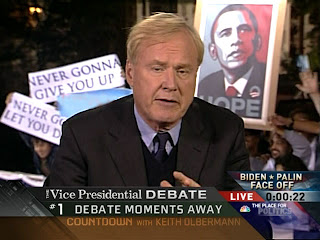
It's not the first time somebody's held up a funny sign for the camera during an ostensibly serious news event. Perhaps, then, it's not an historic moment, but it does seem potentially to be an historically memorable expression of the Zeitgeist. It seems to say something important about what Generation Y thinks is funny, which is a funny thing, or what they think is serious, which is a serious matter.
I recently read an interview with Woody Allen in which he noted that today's smart kids appear to have the same taste as today's dumb kids, preferring the lowest forms of humor to anything approaching art, bored by Bergman and in raptures over one idiot kicking another idiot in the nards on Jackass. I say he "noted" it, rather than "complained," because the man's smart enough to know that what's past is past - no vehemence of nostalgia can recapture a dead era. One commenter on the interview, while misunderstanding this latter distinction, had an interesting reply: You, Mr. Allen, don't understand our humor today - everything is ironic, so part of the fun of watching someone getting kicked in the nards is the fact that we know that's a stupid thing to find funny. Well okay, but isn't that rather miserably fin de siecle? If we have nothing genuinely funny or engaging or interesting today, the distinction between funny or engaging or interesting and ironically funny or engaging or interesting is bound to be lost on the next generation. This is exactly what decadence, in its proper historical sense, looks like. It is irony so universal as to become cynicism.
That said, I don't mean to imply that the sign-holders behind Chris Matthews were missing the real importance of the moment. It is impossible to disentangle the serious from the entertaining in our contemporary media politics. Certainly the VP debate was, in some genuine and important ways, fake and unimportant. It was a joke, and America was the butt. In short, I can't argue that we aren't in fact at the end of the Enlightenment Era. It is the end of an era, the decadence of something grand, and perhaps that's funny, in a way.

It's not the first time somebody's held up a funny sign for the camera during an ostensibly serious news event. Perhaps, then, it's not an historic moment, but it does seem potentially to be an historically memorable expression of the Zeitgeist. It seems to say something important about what Generation Y thinks is funny, which is a funny thing, or what they think is serious, which is a serious matter.
I recently read an interview with Woody Allen in which he noted that today's smart kids appear to have the same taste as today's dumb kids, preferring the lowest forms of humor to anything approaching art, bored by Bergman and in raptures over one idiot kicking another idiot in the nards on Jackass. I say he "noted" it, rather than "complained," because the man's smart enough to know that what's past is past - no vehemence of nostalgia can recapture a dead era. One commenter on the interview, while misunderstanding this latter distinction, had an interesting reply: You, Mr. Allen, don't understand our humor today - everything is ironic, so part of the fun of watching someone getting kicked in the nards is the fact that we know that's a stupid thing to find funny. Well okay, but isn't that rather miserably fin de siecle? If we have nothing genuinely funny or engaging or interesting today, the distinction between funny or engaging or interesting and ironically funny or engaging or interesting is bound to be lost on the next generation. This is exactly what decadence, in its proper historical sense, looks like. It is irony so universal as to become cynicism.
That said, I don't mean to imply that the sign-holders behind Chris Matthews were missing the real importance of the moment. It is impossible to disentangle the serious from the entertaining in our contemporary media politics. Certainly the VP debate was, in some genuine and important ways, fake and unimportant. It was a joke, and America was the butt. In short, I can't argue that we aren't in fact at the end of the Enlightenment Era. It is the end of an era, the decadence of something grand, and perhaps that's funny, in a way.
Mittwoch, September 10, 2008
Art and youth

I have felt for a while that the Dionysiac wildness I felt in my college years would never return to me, whether because it was put on, because it was a product of hormones or naivete, or because it was a product of a profound unhappiness I never expect to feel again.
But reading Rilke's selected poems lately made me think twice. Rilke was an "artist" to the hilt, creating, in Germany, during and after World War I, completely fantastic poetry, reaching for the eternal verities. Thoroughly sincere "art for art's sake" in such a time and place amazes me. He did this mostly over the course of a decade, during which he never showed signs of considering what he was doing ridiculous, as I realized some might. As I realized I did! Not in his case. The value of what he did is clear enough. But I realized I had decided at some point that my own artistic aspirations were ridiculous, that it was all childishness and intellectual masturbation. It was THAT, I think, that put out the fire in me. Never consciously or all at once, I had slowly put more and more distance between myself and my art, increasingly calling the seriousness I had once wished to bring to it artifice and self-indulgence.
So perhaps I don't want that which I have lamented before as impossible - the return of youth. I thought that only with a return of youth could I return to art. But that was wrong, wasn't it? What I must do is not return to art obliquely, but grasp it by the throat, cover it in kisses, slap it, pet it. I have been the wallflower of art, hiding my yearning under feigned disinterest, calling it names, abusing my love for it in order to soften the blow of my loss. I went from thinking I wasn't good enough to art to telling myself it wasn't good enough for me.
But reading Rilke reminded me that it can be good enough. Rilke's poetry was the first new thing I've read in many years that attempted to achieve high art and, to my reading, made it. I've read a lot of great novels in the past couple years, but they didn't have the same artistic ambition, being at least equally concerned with entertainment. Ulysses had the ambition, of course, but seemed insincere to me, a bunch of stunts. And it is that artistic type - the fraud - that has seemed to predominate in my personal experience and tends to dominate this cynic's imagination of the typical artist. At some point I suppose I came to doubt there were anything but frauds. But Rilke - and he's not my favorite poet, though I see his greatness - is not a fraud. I'm also reading Flaubert's letters - also not a fraud. These men loved and lusted after something real - lets call it the Muse, for lack of a better term. Now I'm coming for her.
The apotheosis of political correctness

One insufficiently noted aspect of the current presidential election is the historic apotheosis of "political correctness." By this I mean attacks on the opponent based on convenient principles asserting that certain statements are not to be allowed because they might offend.
One of the problems with political correctness, as it was originally conceived, was that it was often unclear whether anyone was in fact offended by a given statement, or how strongly felt that offense might be. This problem is magnified in the current environment, in which it has become clear that there have been many cases in which no one at all was offended by a statement, but the opposing party took up the statement as a cudgel on the theoretical basis that it could offend - "lipstick on a pig," for instance. This is meant only partly to inspire a sense of offense in those the theory asserts should be offended; it is more powerfully intended to undercut the moral authority of the opponent by offending the moral righteousness of those many millions (in some cases the entire population) who could never be personally offended by the statement per se.
What interests me about this is that it seems to be trumping every other kind of argument. Civilized behavior seems to have become confused with some sort of fictive, perfect political correctness, which judges everything from candidate's families to their level of honesty to be unmentionable by the opponent. The candidates - mostly the Republican side, but the Obama people are playing too - seem to to be mainly concerned with staking out the highest territory on Mount Outrage. Promises from both sides to shun negative campaigning have not until recently been dropped in favor of traditional negative campaigning, but nevertheless have long been dropped - in favor of negative attacks claiming outrage at the negativity of the opponent's campaign.
So it seems to me the chickens are coming home to roost for liberals who thought it was a good idea to declare various kinds of speech out of bounds. It turns out the enemy can play that game just as well, with the inevitable consequence - escalation. The outrage arms race is banning more and more innocent statements, leaving no content but the feigned outrage itself. We free speechers told you so.
Abonnieren
Posts (Atom)